
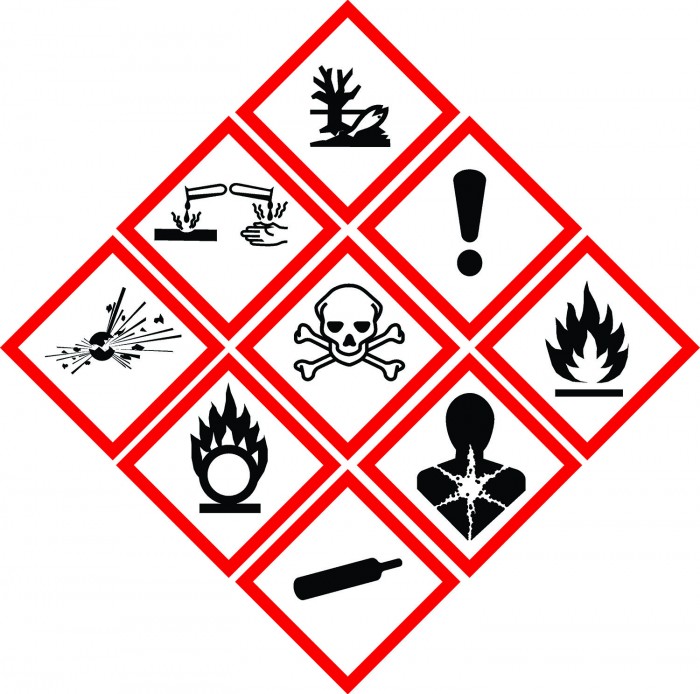
The Globally Harmonized System of Classification and Labeling of Chemicals (GHS) is an international system of hazard communication meant to provide a consistent framework for communicating the hazards of chemical products. The United States adopted GHS revision 3 with a phase in period of 2013 to 2016. The United Nations revises GHS every two years to further refine the language and address hazards of concern not addressed in previous revisions. There are in-process activities in the United States to adopt revision 7 which may affect existing SDSs in the future.
The GHS system addresses both the safety data sheet (previously called material safety data sheets in the U.S.) and the hazard communication on the product label. The safety data sheet was loosely defined in the original U.S. OSHA 1910.1200 Hazard Communication regulations and did not always follow a standard format with many U.S. not adequately addressing the hazards of the product. GHS identifies a 16 section format for SDS. Sections 14 through 16 are included on U.S. SDSs but OSHA has no authority to enforce these sections. The hazard information for the label is standardized with special pictograms and phrases included in Section 2 of the SDS.
Although meant to universally communicate hazards with a consistent language, various countries have adopted different revisions of GHS and adopted it with different emphases creating some diversity amongst requirements of the various countries already adopting GHS for hazard communication.
What is the Purpose of the SDS and The Label Warnings?
If you familiarize yourself with the GHS system, the pictogram system and the phrasing immediately provide the basics of the degree of hazard and precautions required to use the product. Further reading of the safety data sheet provides more detailed information on any specifics of recommended personal protective equipment, fire safety, disposal, etc. The label and SDS combined are an INFORMATIONAL system to be consulted when using the product.
Do I need to test my product as part of creating an SDS?
The GHS system relies on existing physical and toxicological information with mathematical formulas developed to determine toxicity for chemical mixtures. Some testing is needed for the mixtures – typically pH, flash point, density, corrosivity, possibly trace level contaminant measurements such as heavy metals, etc. depending on the specific mixture but it is generally minimal with reliance on existing information for the components. When testing is performed, however, there are standardized test methods defined in GHS that should be followed.
AUTHORING A SAFETY DATA SHEET (SDS)
The American Industrial Hygiene Association (AIHA) SDS/label authoring registering is an important mechanism for identifying those who have demonstrated capabilities in authoring SDSs and labels. LEGEND identifies the specific registered author creating the SDS on the sheet. Most products are mixtures of chemicals. Chemicals can present different hazards depending on their combination and their concentrations. A knowledge of chemistry as well as health and safety is important to developing a usable SDS. The SDS must be useful for a wide audience with varying skills in understanding health and safety without causing confusion or non-compliance with needed safety and health procedures. LEGEND’s process reviews the product chemistry, identifies any testing to define hazards (pH, flash point, concentrations of specific chemicals not well defined such as crystalline silica, heavy metals, formaldehyde, etc.), reviews the most current SDSs for mixture components, and incorporates any unique client requirements (company logo, explanatory language, etc.) to make the SDS unique to the client and educate clients as to the “whys” of certain requirements, language, pictograms, hazard phrases, etc.
What about Other Countries?
The GHS systems was intended to be global but it is not adopted in the same manner by the countries that have adopted it. Many countries have their own formats that differ from what is acceptable in the United States. In most cases, existing U.S. compliant SDSs information can be used to create sheets that are compliant with other Country requirements where environmental hazards, and differences in shipping regulations are important.